Local SEO and Organic Growth
How many Google reviews does your business need? (and why consistent reviews matter more)

Short answer: There's no single magic number of Google reviews your business needs. What actually moves your local ranking and your bookings is a steady, ongoing flow of reviews, not a one-time push to hit 50 or 100. If you're chasing a specific target, you're solving the wrong problem.
Is there a "right" number of Google reviews?
No. Google has never published a specific review count you need to hit. Its own guidance on improving local ranking says reviews feed into "prominence," one of three ranking factors alongside relevance and distance, and that more reviews and positive ratings can help. That's it.
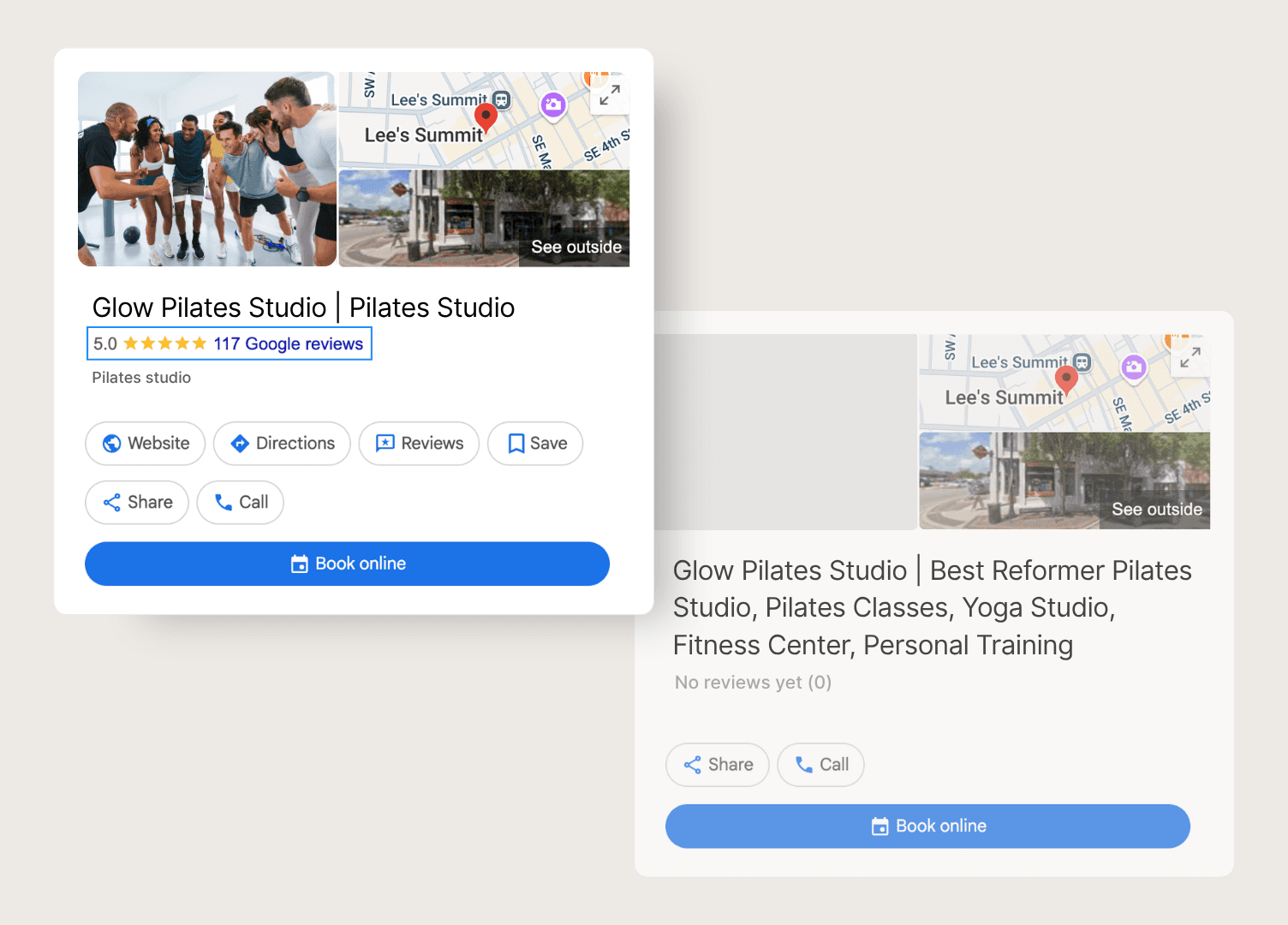
Profiles with a visible star rating stand out next to ones that look blank in search results
You'll find plenty of blog posts online claiming the magic number is 10, or 25, or that you need to average 47 reviews to crack the local map pack. Some of those numbers come from real studies of what top-ranking businesses tend to have, and they're worth knowing as a rough benchmark. But they're observations about correlation, not a rule Google enforces. A business with 12 recent, thoughtful reviews can easily outperform a competitor sitting on 80 reviews that stopped coming in two years ago.
The honest answer: aim to be competitive with businesses in your area and category, and don't stop once you get there.
Why review count still matters for showing up locally
Reviews aren't just social proof for the person reading your profile. They're a signal Google actively uses.
Google's own help documentation is direct about this: reviews and ratings are part of how it judges a well-known and trusted business. This is one of the three things that decides who shows up in local search results and the map pack. On top of that, Google won't display a star rating on your profile at all until you've built up a base of reviews, and a bare profile with no visible rating tends to get skipped over in favor of one that has stars showing.
So review count isn't vanity metric territory. It's tied directly to whether new clients ever see you in the first place.
What matters more than the number: consistency
Here's the part most owners miss. A business that gets 3 to 5 new Google reviews every week, month after month, tends to look a lot healthier to Google (and to a potential client scrolling past your profile) than one that got a burst of 40 reviews last spring and nothing since.
Recency matters. Frequency matters. A profile that shows fresh activity signals that real clients are walking through your door right now, not two years ago. A pile of old reviews with a long gap after them can actually read as a warning sign to someone deciding whether to book a session.
This is why "how many reviews do I need" is the wrong question to build a strategy around. The better question is: do I have a system that brings in a few new reviews every single week, without me having to remember to ask?
How often should you be asking for reviews?
Every client interaction is a chance to ask, especially right after a good one. A first class that went well. A service the client loved. A session where they mentioned feeling stronger. That's the moment, not three weeks later when the feeling has faded, and they've forgotten the details.
The businesses that keep a steady flow going usually aren't doing anything more clever than this: they ask consistently, right after a positive moment, and they make it require almost no effort from the client.
How do you ask for a Google review without sounding pushy?
Asking for reviews can be awkward, but keep it short, specific, and tied to something real that just happened. Vague asks ("would you mind leaving us a review?") get ignored more often than specific ones that reference the actual visit.

A simple example you can copy
Text or email, sent within a day of the visit:
"Hey [name], so glad you loved your first session with us! If you have 30 seconds, we'd really appreciate a quick Google review; it helps other people in the neighborhood find us. Here's the link: [your review link]."
Short, specific to what just happened, and it makes the ask feel like a favor between people, not a form to fill out.
What happens when you automate review requests
Sending review requests one by one gets old fast. Automate it instead, and let it run quietly in the background while you focus on clients. That's exactly what Dawn Tucker did.
Dawn owns Align Yoga and Pilates in Tillsonburg, Ontario. Between teaching and running the studio floor, she barely had time to chase reviews manually. So she set up automated Google review requests through Kenko AI, sent to regulars after a positive interaction.

The result: her studio collected 25 new Google reviews in 24 hours, with nine five-star reviews landing in the first four hours alone. That steady flow of authentic, recent reviews is a big part of why her studio now ranks #1 locally for "Pilates" and #2 for "yoga" in her area. New leads find her profile, book directly from the "book now" button on Google Maps, and land in an automated follow-up sequence that turns first-timers into regulars.
"The amount of reviews that we received just from our automation set up... was remarkable," Dawn said. "Some of them were really personal; one had me tearing up."
Read the full Align Yoga and Pilates story for more on how the automation works behind the scenes.
If you want a clearer picture of where your own profile stands, get your free growth assessment and see what's actually holding your local visibility back.
Frequently Asked Questions
How many Google reviews do I need before a star rating even shows up?
Google requires a small base of reviews before it will display a star rating on your profile. Without that visible rating, your listing shows up bare next to competitors who have one, which tends to cost you clicks even if your service is just as good.
Can getting too many reviews at once hurt my profile?
A sudden, unnatural flood of reviews all at once can look suspicious to Google's spam detection systems, whether or not anything was actually done wrong. A steady trickle spread across weeks looks far more natural than a single burst, which is another reason consistency beats a one-time push.
Do I need reviews on other sites too, or just Google?
Google is the highest-priority platform for local visibility since it directly affects Maps and local search rankings, but a presence on other relevant review sites for your industry adds to your overall credibility and can appear alongside your Google listing.
What's the fastest way to ask a client for a Google review?
Share your direct Google review link or QR code right after a positive interaction, ideally the same day. You can also automate the entire process using platforms like Kenko AI. The easier you make it for the client, the more likely they follow through before the feeling fades.