Local SEO and Organic Growth
Why competitors outrank your studio on Google Maps (and 5 ways to beat them)

Short answer: Most competitors don't outrank you because they've been open longer or spend more on ads. Google ranks local businesses on three signals: relevance, distance, and prominence. If a competitor's Google Business Profile is more complete and pulls in more recent reviews than yours, they'll show up first, even if your business is better.
You've done the work. The space looks good, clients love it, word is spreading. But when someone new searches "pilates near me" or "best salon near me," you're not the one they find. A competitor with a different experience shows up above you.
It comes down to your Google Business Profile, and that's something you can fix today.
Why do competitors outrank you on Google Maps?
Google decides who shows up in local results using three factors: relevance (how well your profile matches the search), distance (how close you are to the person searching), and prominence (how well-known and trusted you are, based on reviews, mentions, and links). A competitor who's stronger on any of these, prominence especially, will usually rank above you.
The 3 ranking factors Google actually uses
Ranking factor | What it actually means | Can you influence it? |
Relevance | How well your profile and category match what someone searched | Yes. Categories, services, and a complete profile |
Distance | How close you are to the person searching | Not directly, but service-area settings help |
Prominence | How well-known and trusted your business looks online | Yes. Reviews, citations, and consistent activity |
If you're losing to a competitor, it's almost always a relevance or prominence gap, not a distance problem you can't control.
Why "they've been around longer" isn't the real reason
It's tempting to write off a competitor's ranking as "they've just been here longer" or "they have way more reviews." Sometimes that's part of it. But Google isn't just counting years in business or total review volume. It's reading completeness, category accuracy, review recency, and activity, all things a newer or smaller business can outdo with the right setup. (More on that shortly, because one studio did exactly this against 10+ competitors.)
Why isn't your business showing up on Google Maps at all?
If you're not ranking low but missing entirely, the cause is usually one of four things: your profile was never claimed and verified, a duplicate listing is competing with the real one, the profile was suspended for a guideline issue, or your address or category doesn't match what's on file. Each of these has a specific, fixable path.
This is a different problem than ranking low. Ranking low means Google sees you but ranks a competitor higher. Not showing up at all usually means Google can't confidently attach your business to that search yet.
If this is happening | Likely cause | What to do |
You can't find your own business by name | Profile was never claimed or verified | Verify your business on Google |
Two listings show up for the same address | Duplicate profile splitting your reviews and signals | Resolve the duplicate or request a merge |
You were ranking, then vanished | Suspension or a guideline violation | Check your email for a notice from Google and review your profile against current guidelines |
Wrong address, hours, or category shows up | Info mismatch between your website and profile | Correct the details in your profile and resubmit |
How do you rank higher on Google Maps than your competitors and 5 ways to win
The fastest path to outranking a competitor on Google Maps is closing the gaps in your Google Business Profile: complete every field, keep reviews coming in consistently, match your business info everywhere it appears online, stay active with photos and updates, and, if you run more than one location, treat each one as its own listing. None of these require a bigger budget than your competitor's.
1. Claim, verify, and fully complete your Google Business Profile
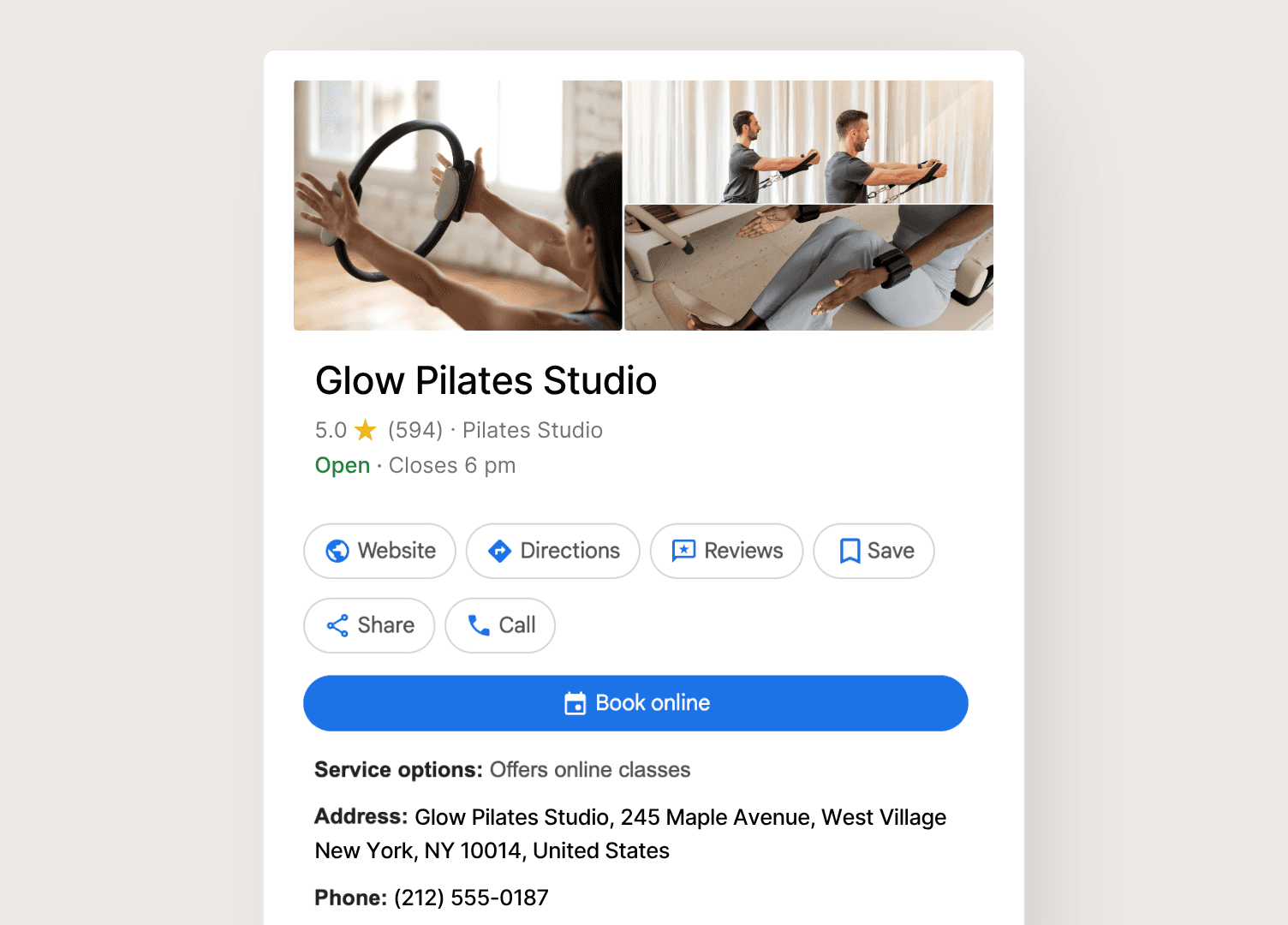
A fully completed profile gives Google more to match you to the searches you actually want.
Google is straightforward about this: businesses with complete, accurate info are more likely to show up for relevant searches, and incomplete profiles can get skipped entirely. That means your full address, real business hours, the right primary category, and every attribute that applies (parking, accessibility, booking links) filled in, not left blank.
Most studios do this once at setup and never touch it again. Competitors who keep it current are the ones Google trusts more.
2. Build steady review volume, not a one-time push
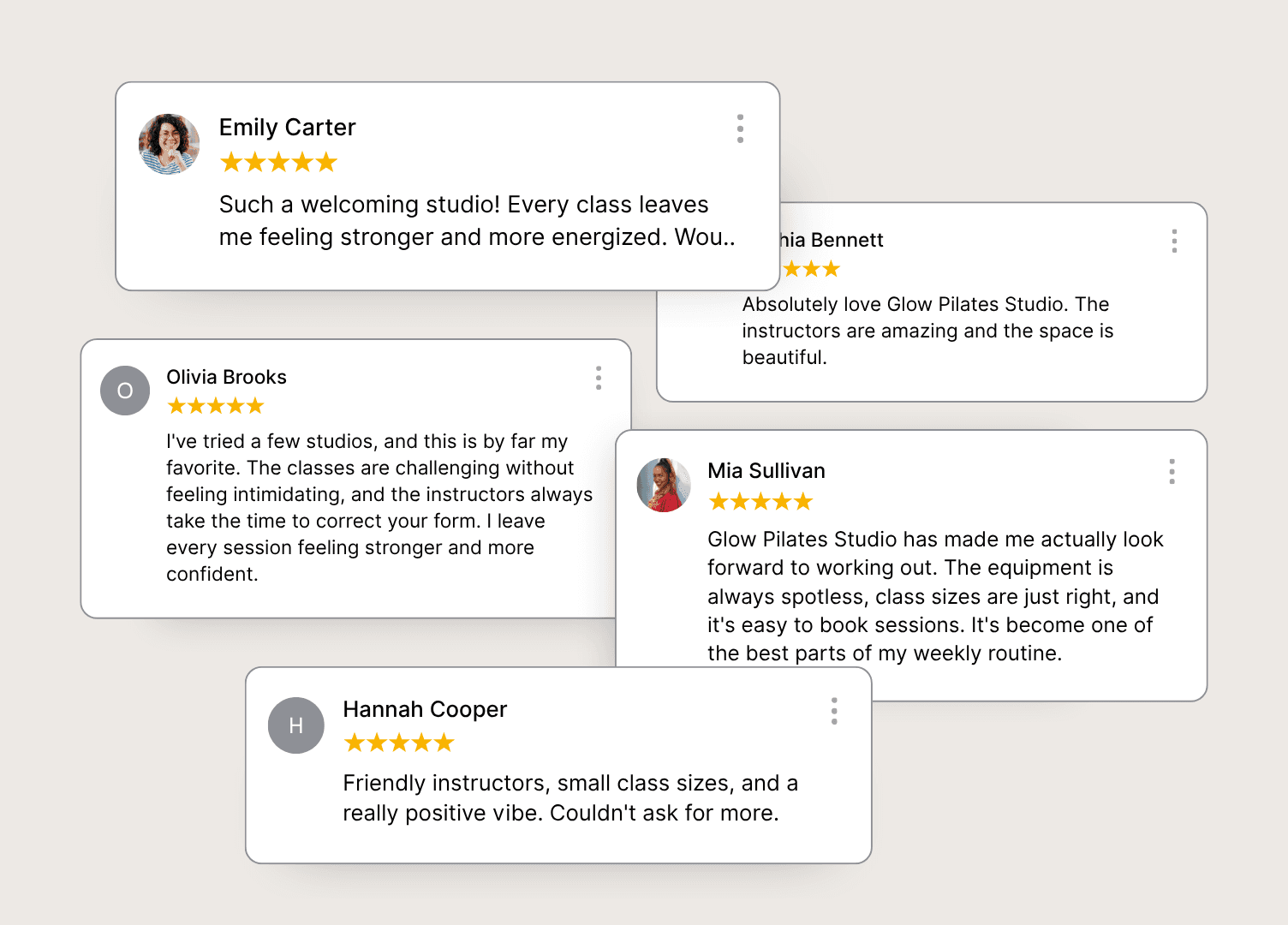
Recent reviews carry more weight than a big pile of old ones nobody's added to in months.
A burst of 20 reviews the week you open, then silence for a year, tells Google your business went quiet. Reviews that keep coming in, and that you reply to, signal an active, trusted business. That steady signal matters more for prominence than a high total count sitting untouched.
Ask after every good experience, not just once. A simple text or app prompt right after a class, appointment, or service works better than a generic email blast weeks later.
3. Fix your NAP consistency across the web
NAP means your business Name, Address, and Phone number. If your website says one address, your Facebook page says another, and an old directory listing has your previous phone number, Google has a harder time trusting any single version, which weakens prominence. This is one of the most common, most overlooked gaps for growing businesses, especially after a move or a rebrand.
Search your business name and check what comes up across your website, socials, and any directory you're listed in. Fix mismatches wherever you find them.
4. Keep your profile active with photos, posts, and updates
Posts aren't a direct ranking factor on their own, but they keep your profile active, which supports the engagement and trust signals Google is watching for. Real photos of your actual space, your team, and your work do more here than stock images ever will, and they give potential clients a reason to click through instead of scrolling past.
Add new photos regularly. Post updates when something changes: new hours, a new service, a seasonal offer, or a workshop.
5. Treat every location's profile as its own listing
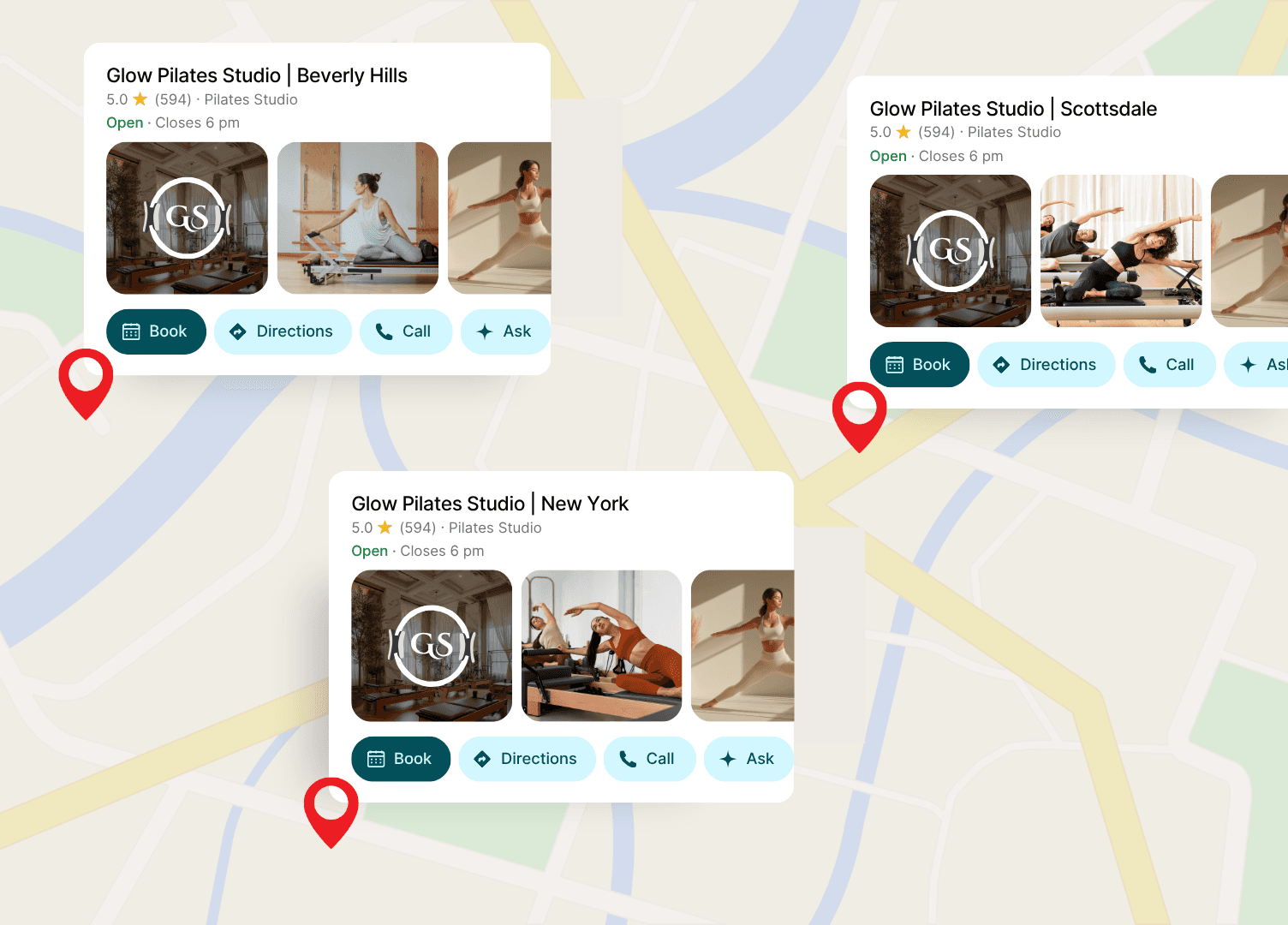
Every location needs its own complete, active profile, not a copy of your busiest one.
If you're running 2 or more locations, this is where most multi-location businesses lose ground without realizing it. Each address needs its own fully built-out, actively managed profile. A strong flagship location doesn't help a newer or quieter second location rank, because Google evaluates relevance, distance, and prominence separately for each address.
How did an NYC Pilates studio outrank studios with years of history and way more reviews?
SoHo Pilates opened in one of Manhattan's most competitive Pilates markets, surrounded by 10+ competing studios within 0.7 miles and an average competitor review count of 125. Within their first 90 days, and with only 28 reviews of their own, they ranked #1 for searches like "pilates near me" and "pilates studio near me," ahead of studios that had been open for years.
Matt and Madeline, co-owners of SoHo Pilates, knew opening in SoHo meant competing against businesses with years of local recognition and hundreds of reviews already banked.

SoHo Pilates outranked studios with 4x its review count within 90 days of opening.
Instead of trying to outspend that competition with ads, they used Kenko's Luna to get their Business Profile and local SEO fully built out from day one. Within three months, they were showing up more consistently in local Pilates searches than studios that had been open for years, capturing top rankings for terms that didn't even mention their name directly. 83% of those searches came from mobile, the exact moment someone's curiosity is fresh enough to become a booking.
What this means for any appointment-based business: having the right profile setup mattered more than how long a competitor had been around or how many reviews they'd stacked up. Age and review count are advantages, not guarantees.
How long does it take to rank higher on Google Maps after making changes?
Profile edits themselves usually show up in search results within a few days. Actually climbing in a competitive local pack typically takes several weeks to a few months, since review volume, consistency, and activity signals need time to build. SoHo Pilates reached #1 for several high-competition searches within 90 days of opening from a completely new profile.
There's no universal timeline because it depends on how strong your competitors' prominence signals already are. A quiet market might show movement in a couple of weeks. A dense one, like SoHo, takes longer, but it's achievable if the profile work is done right and reviews keep coming in.
These five fixes are the foundation of any local SEO strategy for a boutique service business, whether you're running a Pilates studio, a salon, a med spa, or a wellness practice. None of it requires outspending anyone. It requires outbuilding them on the profile itself.
Want a clearer picture of where you actually stand against the competitors near you? Start your free growth assessment, or grab Kenko's Local SEO Playbook for a step-by-step walkthrough you can run yourself.
Frequently asked questions about ranking on Google Maps
How do I find out why a specific competitor outranks me?
Pull up their Google Business Profile next to yours and compare category selection, profile completeness, review count and recency, photo quality, and how consistently their name, address, and phone number appear elsewhere online. That side-by-side comparison is the core of any competitor SEO analysis you can do yourself. If you'd rather have someone run that audit for you, Kenko's free growth assessment does exactly this and shows you where you're losing ground.
Can I pay Google to rank higher on Google Maps?
No. Google states directly that there's no way to pay or request a better local ranking. Rankings are algorithmic and based on relevance, distance, and prominence, not ad spend or account tier.
Does having multiple locations hurt my Google Maps ranking?
Not inherently. Google ranks each address on its own relevance, distance, and prominence, so a second or third location isn't penalized just for existing. The real risk is treating newer locations as an afterthought: thinner profiles, fewer review requests, less consistent info. Multi-location businesses that keep every profile equally strong tend to outperform ones that only maintain their original flagship.
Why did my Google Maps ranking suddenly drop?
A handful of common causes: a lapse in responding to reviews, a change to your address, hours, or category that created a mismatch, a duplicate listing competing with your main one, a broader Google algorithm update, or simply a competitor closing the gap by improving their own profile. Check your Business Profile for recent notices first, then work through the checklist above.