Strategy
The client lifecycle danger zones: What happens at day 0, 14, 45, 60, 90

TL;DR Most client churn does not happen randomly. It clusters at five predictable points in the first 90 days: the day someone books, day 14, day 45, day 60, and day 90. Client lifecycle management means watching those five moments closely instead of only noticing a client is gone once they stop showing up.
What is client lifecycle management, and why does it matter for retention
Client lifecycle management is the practice of tracking a client's relationship with your business from the moment they first book to the point they either become a regular or fade out, and stepping in at the exact moments that decide which one happens.
Most boutique owners already track new bookings and total client count. Far fewer track what happens to a client between those two points. That gap is where retention gets lost.
This matters because the economics are lopsided. Research popularized by Bain & Company and Harvard Business Review found that increasing customer retention by just 5% can increase profits by 25% to 95%, and that acquiring a new customer typically costs 5 to 25 times more than keeping an existing one. That gap holds across industries, and it holds for a boutique studio, salon, or spa competing on repeat visits (Harvard Business Review, "The Value of Keeping the Right Customers," October 2014).
In other words, client retention is not a nice-to-have next to acquisition. For a boutique business, it is usually the bigger lever.
Why churn is not random but how it happens in predictable danger zones
Client retention data across boutique verticals shows the same pattern: attrition is not spread evenly across a client's life with your business. It piles up at specific, predictable points.
In the fitness industry, the Health & Fitness Association's 2025 Fitness Industry Benchmarking Report, based on data from 175 companies and more than 17,000 facilities, found that annual member retention averaged 66.4% for the year, meaning roughly one in three members leaves annually (HFA 2025 Fitness Industry Benchmarking Report).
In salons and spas, industry data compiled by client management platform Meevo shows the same shape of problem from a different angle: the average business only retains about 35% of first-time clients for a second visit, while existing clients who make it past that point are retained at closer to 75% (Meevo, "Calculating Client Retention Rate in the Spa and Salon Industry").
Different verticals, same story. Clients do not drift away steadily. They drop off in clusters, at the moments when a business is least likely to be watching.
Day 0: What happens the moment someone books their first appointment
Day 0 sets the trajectory for everything that follows. How a new client is welcomed and set up on their first visit has more influence on whether they stay six months later than almost anything you do afterward.

What happens in the first five minutes of a client relationship often decides what happens five months later.
This is not just intuition. Industry data compiled by ABC Fitness shows that members who are properly onboarded and establish a habit within their first 12 weeks retain at 87% at the six-month mark, a meaningfully higher rate than members left to figure things out on their own (ABC Fitness, "Fitness Industry Statistics 2026").
For a boutique business, day 0 usually comes down to a few unglamorous things done well: confirming the booking clearly, setting expectations for what the visit will involve, and making sure the client leaves knowing what happens next. It sounds small, but it is the highest-leverage moment in the entire relationship.
Day 14: Why new clients quietly check out two weeks in
By day 14, a new client should already have a second visit booked or completed. If they do not, that gap itself is a warning sign, not just a neutral pause.
Retention research cited by ABC Fitness found that roughly 15% of new members take a full two weeks just to make their first visit at all, a delay that itself flags elevated churn risk (ABC Fitness, "Fitness Industry Statistics 2026").
The same pattern shows up in salons and spas, where a huge share of first-time clients never return for a second visit in the first place, per Meevo's benchmark of roughly 35% new-client retention industry-wide (Meevo).
Day 14 is not the moment to panic. It is the moment to notice. A client who has not rebooked by two weeks out is telling you something, even if they have not said a word.
Day 45: The mid-lifecycle slump most businesses never see coming
Day 45 sits right at the edge of the window where research shows cancellations start to concentrate, and it is also where the natural gap between appointments starts to work against a business that is not paying attention.
ABC Fitness data shows that most cancellations across the fitness industry happen between roughly month two and month four of a membership, not in the first few weeks and not much later (ABC Fitness).
Forty-five days in is early enough that a client has not consciously decided to leave. It is late enough that if nothing prompts them back, they are already drifting.
Day 60: The point where a client becomes a regular or disappears
Day 60 is where the six-to-ten-week gap that boutique businesses live inside really tightens. A client who has not been prompted back by this point is close to the edge of the window where they either rebook or quietly stop being a client at all.
This is also where the "your neighborhood was always your best marketing channel" idea earns its keep. A client who feels forgotten at day 60 does not usually complain. They just book somewhere else nearby, often somewhere that reached out first.
At day 60, the question worth asking is not "did they cancel." It is "did anyone reach out?" Waiting for a client to raise their hand is the same as waiting for them to leave.
Day 90: The last real window to win back a fading client
Day 90 is the point most retention benchmarks treat as the deadline. If a client has not returned by day 90, industry data consistently shows they are very unlikely to come back on their own.
Widely cited fitness industry figures, drawing on Health & Fitness Association benchmarking, put it plainly: roughly half of new members who quit do so within their first six months, and most of that drop-off happens by day 90.
Past day 90, a lapsed client stops being a retention problem and becomes a reactivation project, which is a slower, more expensive conversation to have. Everything upstream of day 90 exists to avoid needing that conversation at all.
How to build a client lifecycle system that catches every danger zone
A client lifecycle system does not need to be complicated. It needs three things: automated touchpoints at the moments that matter, a way to catch dissatisfaction early, and a habit of actually looking at the data.
Knowing the danger zones is only useful if something happens at each one. Here is what that looks like in practice.
Automate the moments that matter most
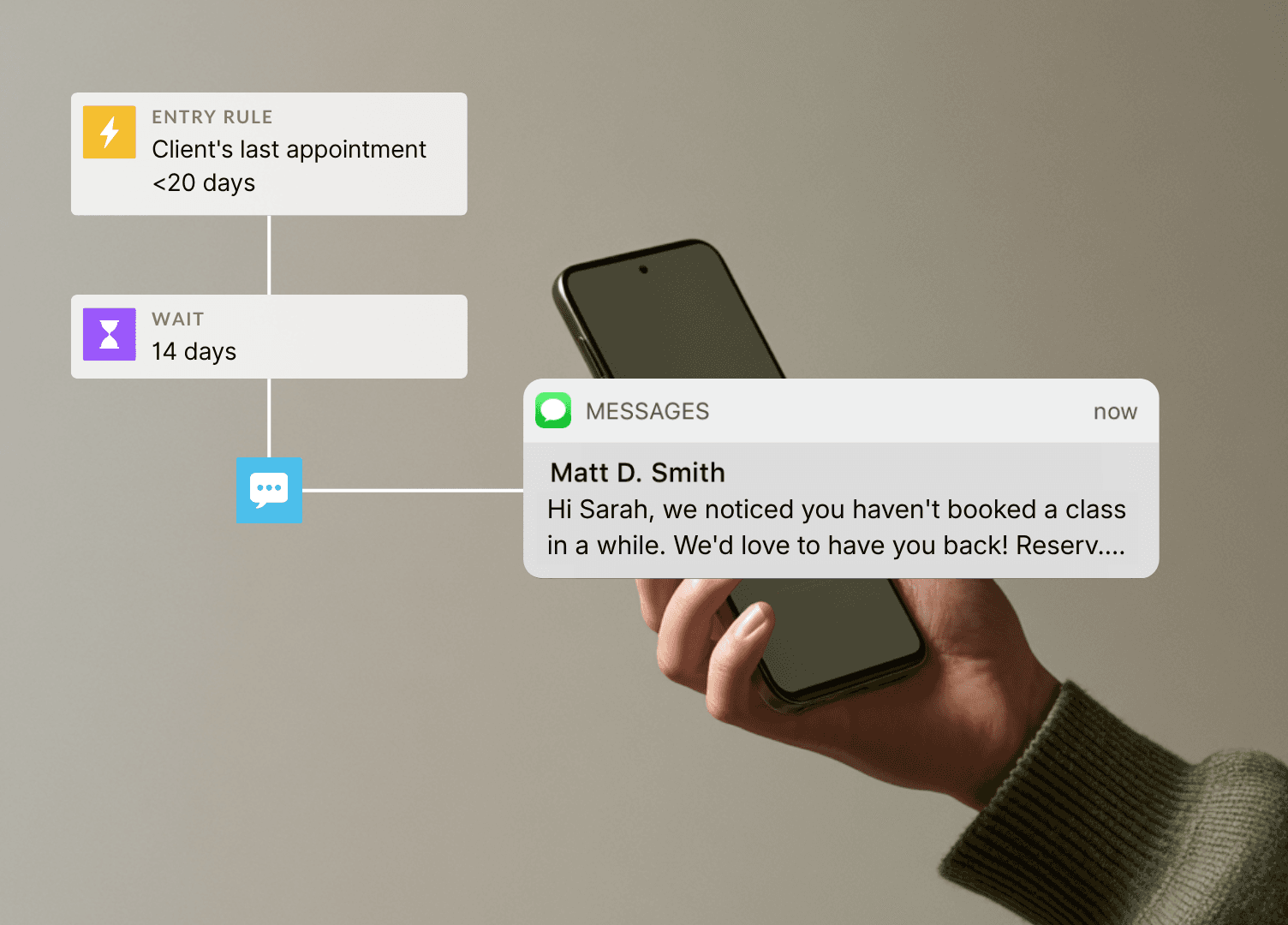
A single well-timed message is often the difference between a client who rebooks and one who quietly disappears.
Nobody on a boutique team remembers to personally check in with every client at day 0, 14, 45, 60, and 90. That is not a discipline. This is where automated, timely messaging earns back the hours a small team does not have.
Kenko AI's automations (Journeys) are built to handle exactly this kind of scheduled outreach: a welcome message at day 0, a gentle nudge if a first-time client has not rebooked by day 14, a check-in around the day 45 to 60 window before a client drifts, and a win-back message before day 90 closes the door. The goal is not more messages. It is the right message at the moment it actually changes an outcome.
Use feedback to catch risk before it becomes a cancellation
A couple of check-ins, the kind that ask a simple "how likely are you to recommend us" question at the right moment, give a business an early read on who is drifting before they act on it.
This is also where retention and referral connect. A client who is happy enough to recommend you is a client who is not going anywhere, and turning that goodwill into an active referral program keeps new clients arriving through the channel that costs the least and sticks around the longest. If your business does not have a structured referral program in place, Kenko AI helps businesses set up a referral program that is built around exactly this idea: organic, community-driven growth rather than another paid channel.
Make lifecycle tracking a daily habit, not a quarterly review
A danger zone is only useful information if someone sees it while there is still time to act. Waiting for a monthly or quarterly retention report means finding out about a day-45 problem on day 90.
This is where an agent like Watson, Kenko AI's reporting layer, does the unglamorous but valuable work of surfacing which specific clients are drifting out of a danger zone right now, not at the end of the month. Consistency, not another dashboard.
Why multi-location businesses need to manage the lifecycle at every location, not just the flagship
At 2 to 5 locations, consistency becomes your superpower, and that includes consistency in how every location handles the same five client lifecycle danger zones.
A single-location owner can often catch a drifting client by instinct, because they know most of their clients by name. That instinct does not scale to a second or third location. A day-14 gap that a flagship manager would notice immediately can go completely unnoticed at a newer location with a newer team.
The businesses that grow smoothly past their second and third location are usually the ones that have turned client lifecycle management into a system rather than a habit that lives in one manager's head. The same welcome sequence, the same check-in cadence, and the same win-back trigger, running identically whether a client walked into location one or location four.
Want to see where your own business is losing clients across these five checkpoints? Get your growth assessment and find out which danger zone is costing you the most, or browse real growth stories from boutique businesses that have tackled this before.
Frequently asked questions about client lifecycle management
What is a good client retention rate for a boutique business?
It depends on the vertical, but the benchmarks give a useful anchor. In fitness, the industry-wide average annual retention rate is 66.4%, while strong boutique studios tend to land noticeably higher (HFA 2025 Fitness Industry Benchmarking Report).
How often should I check in with new clients during their first 90 days?
At minimum, at each of the five danger zones: a welcome touchpoint at day 0, a rebooking nudge by day 14 if they have not already booked again, a check-in around day 45, a clear prompt to rebook by day 60, and a win-back message before day 90 if they have gone quiet. Beyond those five, more frequent contact rarely adds much and can start to feel like noise.
What is the difference between client retention and customer retention?
Functionally, nothing. "Client retention" is the term more common in relationship-based, appointment-driven businesses like studios, salons, and spas, while "customer retention" is the broader marketing term used across ecommerce and subscription businesses. Both measure the same underlying question: did this person come back?
Can I reduce churn without offering discounts?
Yes, and it is usually the more sustainable approach. Discounting tends to attract price-sensitive clients who are more likely to leave the moment a competitor undercuts you. A better welcome, a timely check-in, and a reason to feel remembered will usually do more for retention than a percentage off.