Local SEO and Organic Growth
Why can't customers find your business on Google? (and 4 easy fixes)

The short answer: If customers can't find your business on Google, it's almost always one of four things. Your Google Business Profile isn't verified, the information on it is incomplete, you don't have enough recent reviews, or your business details don't match across the web. Google builds local results from relevance, distance, and prominence, and each of those four problems weakens at least one of them.
Your studio exists. You've got a great space, happy clients, and a business that's actually working. So why does it feel invisible on Google?
Here's the thing: Google only shows verified profiles in Maps and Search to begin with. But getting verified is just the entry ticket. After that, where you rank comes down to three factors: relevance, distance, and prominence. In other words, how well your profile matches what someone's searching for, how close you are to them, and how well known your business is.
Distance is the one you can't touch. You are where you are.
Relevance and prominence, though? Those are entirely in your control. Relevance comes from how completely and accurately you've filled out your business info. Prominence comes from things like how many sites link back to you and how many reviews you've got, with more (and better) reviews giving you a real ranking boost.
So if customers keep missing you on Google, it's a fixable gap. Here are four easy ways to close it.
Fix 1: Is your Google Business Profile actually verified?
Only verified businesses can show their information on Maps and Search. If your profile was never verified, got suspended, or quietly exists twice, no amount of website work will bring you back into local results.
Start with the test Google itself recommends: search your business name plus your city. If nothing comes up, you might have a verification problem and not a ranking problem.
Three things to rule out:
Never verified. Verification tells Google you're authorized to represent the business, which makes it more likely to show up in search results.
Suspended. If your profile breaks Google's guidelines, it becomes disabled or suspended and won't show to other users until you resolve it. You'll get a notification in the Google Account you use to manage the profile.
Duplicated. Google's guidelines say there should only be one profile per business, because duplicates cause problems with how your information displays on Maps and Search. Two half-strength listings will always lose to one complete one.

Verification is what makes your information eligible to appear on Maps and Search at all.
Fix 2: Is your profile complete enough for Google to match you to a search?
Businesses with complete and accurate info are more likely to show up in local search results. Google says plainly that if your business info isn't accurate, your profile might not show up for relevant searches in your area. Full address, current hours, correct category, real photos.
This is the most common reason a legitimate, verified business slowly disappears from "near me" searches. Nothing broke. The profile just stopped saying enough for Google to confidently match it to what people are typing.
Fill in the full address, your regular hours plus special hours for holidays, what kind of business you are, and practical attributes like parking. Add photos that show the actual space, the actual team, and the actual experience.
The two fields boutique owners get wrong most often
Your business name and your category. Both are governed by rules that most owners have never read, and both can quietly cost you visibility or get your profile suspended.
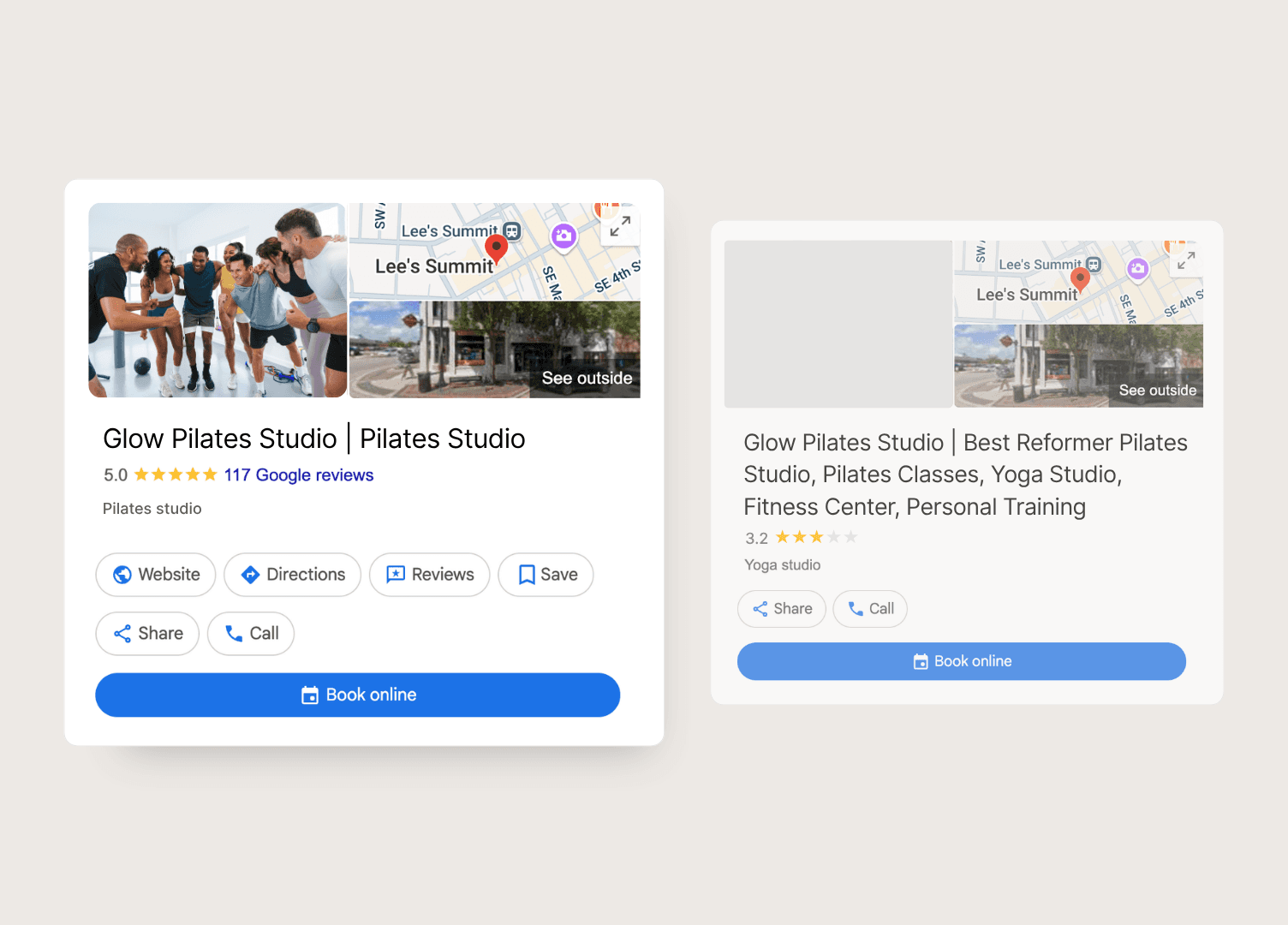
Name. Your name should reflect your real-world name, as used on your storefront, website, and stationery. Adding service or location keywords is not permitted and could result in suspension. "Glow Studio" is fine. "Glow Studio | Best Facials & Massage Downtown" is a suspension waiting to happen.
Category. Pick the fewest categories it takes to describe your core business, and choose them to complete the sentence "this business IS a," not "this business HAS a." Google is clear that you shouldn't use categories purely as keywords. Piling on twelve of them dilutes rather than broadens.
Fix 3: Are your reviews giving Google a reason to rank you?
Prominence is partly built on how many reviews you have and how positive your ratings are. Replying to reviews shows that you value customer feedback and helps your business stand out. A steady flow of recent, replied-to reviews moves local ranking more than most website changes.
Two practical things.
First, make the ask easy. Google supports creating a direct review link or a QR code so people don't have to hunt for your listing. Asking a happy client to "find us on Google" loses most of them.

A direct link or QR code removes the step where most review requests get lost.
Second, don't get clever. Offering discounts or freebies in exchange for reviews is strictly prohibited and treated as fake and misleading content. It can restrict your profile.
The hard part isn't knowing to ask. It's asking in the twenty-minute window after a great appointment, while you're already with the next client. That window is where most review programs die, and it's exactly the kind of follow-up worth handing to your AI rather than your memory.
Fix 4: Does your business information match everywhere online?
Google cross-checks the business details it finds across the web. When your address, suite number, or phone number reads differently on your website, your booking page, and a directory listing from three years ago, you're splitting the signals that build prominence.
Two specifics from Google's guidelines that catch service businesses out. Use a local phone number rather than a central call center line wherever you can, and make sure the number is under your direct control. And your listed address has to be a real location your team staffs and receives clients at, not a virtual office or an unstaffed co-working desk.
What changes when you run more than one location
Google requires that all locations of a business within the same country use the same name, and that locations offering the same service share the same category. Naming one location differently from the others isn't a branding decision. It's a guidelines problem.
At two to five locations, consistency becomes your superpower. Same name, same category, same phone convention, same hours format, and just one profile per location. Owners who treat each location's listing as its own little project end up with five profiles that all rank slightly worse than they should.
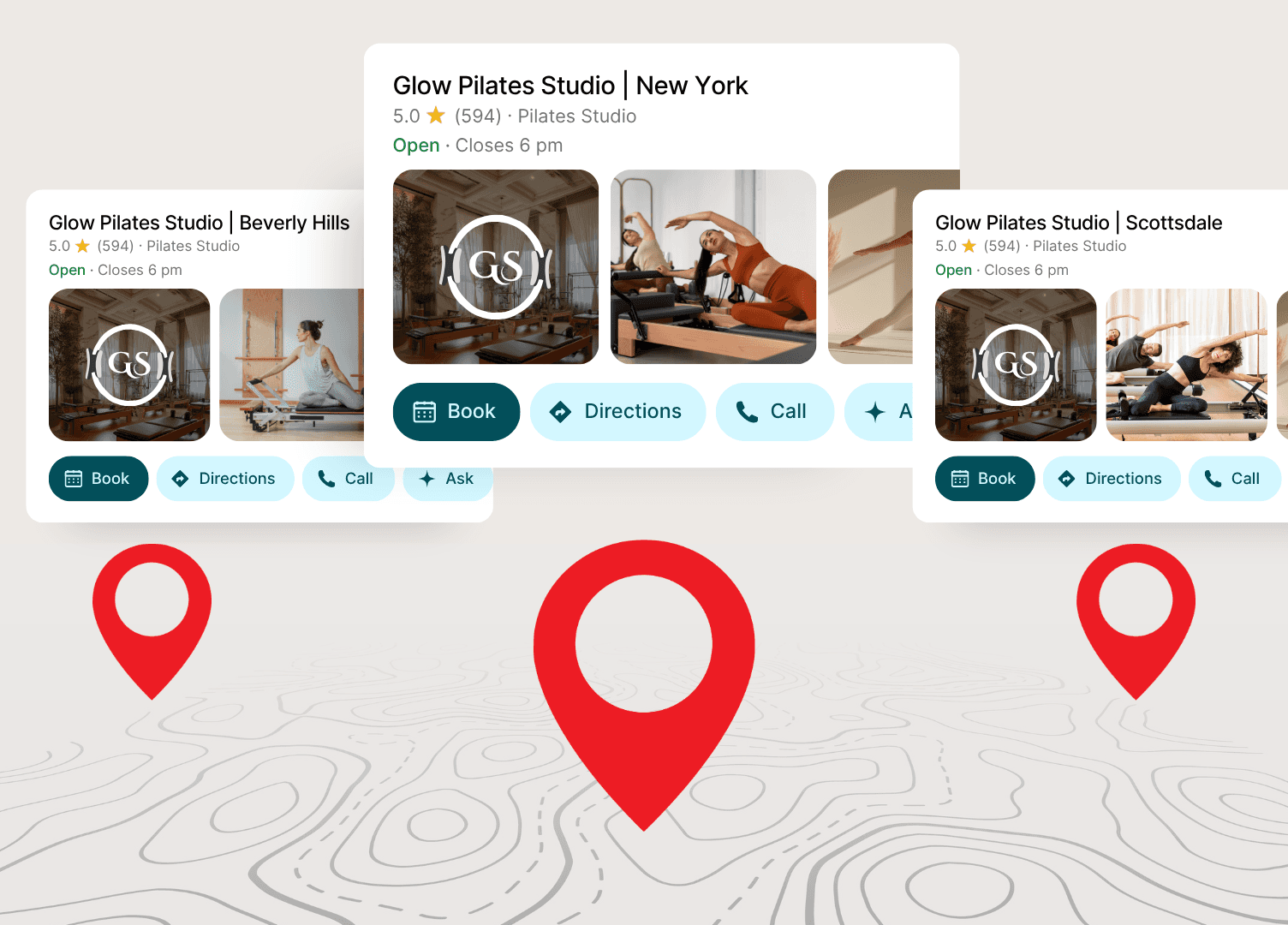
Three locations, one naming convention. This is what consistency looks like in practice.
Agency, DIY, or AI: what actually fits a boutique business?
Most boutique owners try to do this themselves, run out of hours, then hire an agency and pay a retainer for work that is mostly consistency. There's a third option now.
Local SEO agency | Doing it yourself | AI-run marketing | |
What it costs you | A monthly retainer, regardless of month | Your evenings | Part of the system you already run the business on |
Review follow-up | Usually out of scope | Whenever you remember | Triggered off the appointment itself |
Speed of small fixes | Next reporting cycle | When you get to it | Same day |
At 3+ locations | Cost multiplies per location | Realistically stops happening | Same process everywhere |
Who knows your clients | Nobody at the agency | You | Your booking data |
Where it breaks down | You're paying for consistency, not strategy | Good weeks and bad weeks | Still needs your judgment on brand and offer |
That middle column is where most boutique businesses actually live, and it's why local visibility tends to arrive in bursts rather than compound. The direction things are heading isn't hiring a marketing person. It's having a marketing function that runs whether or not you had time this week.
What this looks like when it works
Pilote Pilates opened in Sunset Park, Brooklyn in November 2025 with zero revenue and an empty space. Three months before opening, the owner, Margarita, started working on how the business would show up on Google and Maps, so that people nearby could discover it before they were ready to book anything.
In its first six months, Pilote Pilates reached the #1 spot for "pilates near me" and other local searches in its area. The business was found on Google 10,456 times and drove 1,041 clicks to its website, without running a single Google ad.

Pilote Pilates' Sunset Park location, which reached #1 for "pilates near me" within six months of opening.
None of this is complicated, and none of it costs you anything but time. Fill out your profile completely, keep your info consistent everywhere you're listed, ask happy clients for reviews, and build a few solid links back to your site.
If you'd rather not manage all of that on your own, that's exactly the kind of work Kenko handles for boutique studios and businesses like yours.
Do that, and you stop leaving it up to chance whether the right person finds you at the right moment. You show up. And in a business built on people walking through your door, that's the whole game.
Frequently asked questions
Why is my Google business listing missing all of a sudden?
The two usual causes are a suspension and a duplicate. If your profile violates Google's guidelines it becomes disabled or suspended and stops showing to other users until you fix it, and you'll get a notification in the Google Account that manages the profile. Check that account first.
Does having a website help me rank on Google Maps?
Indirectly, yes. Prominence is based partly on how many websites link to your business, so your own site and consistent listings elsewhere feed into it. But a great website will not rescue an unverified or incomplete Business Profile. Fix the profile first.
How many Google reviews do I need to rank locally?
Google doesn't publish a number, and anyone who quotes one is guessing. What Google does say is that more reviews and positive ratings can improve your local ranking, and that replying shows you value feedback. Treat it as an ongoing habit rather than a target to hit once.
Can I pay Google to rank higher in Maps?
No. Google states there's no way to request or pay for a better local ranking, and keeps the algorithm details confidential to keep the system fair. You can pay for ads, which appear separately from organic local results.
Should each of my locations have its own Google Business Profile?
Yes, one profile per location, and no more than one. All locations in the same country must use the same business name, and locations providing the same service must share the same category. Separate profiles with drifting names split your signals instead of doubling them.